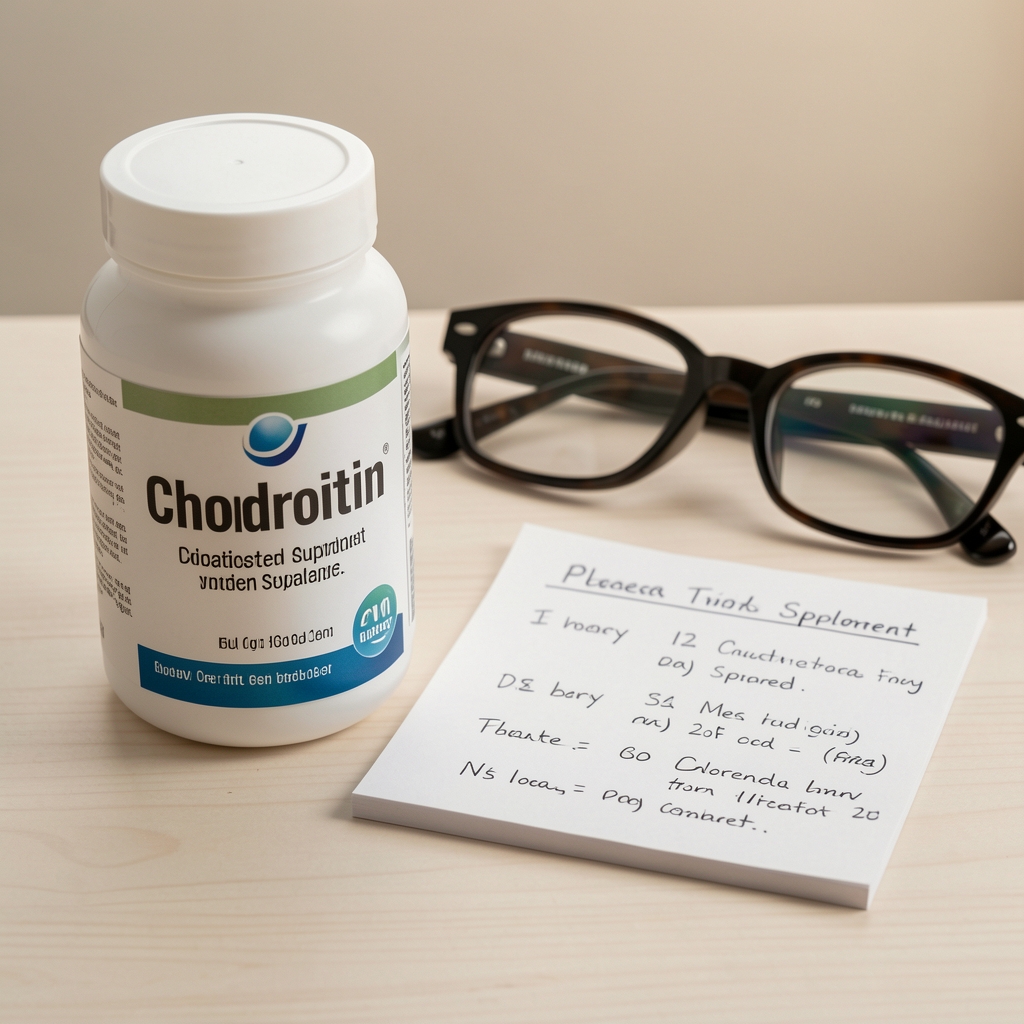
A chondroitin men supplement search can produce a crowded shelf of similar words. The editorial task is to slow that shelf down. A reader needs to distinguish the ingredient name, the amount per serving, the source statement, and the other materials included in the same product before any comparison can be meaningful.
Words carry different weights
Packaging language often places the most familiar ingredient in the largest type. Smaller lines may explain the serving or source. Atalen's reading method moves from large type to small type without assuming that size equals importance. It also records the date of the label and the market where it was seen, since formulations and phrasing can change between printings.
This approach matters in Indonesia because product formats and retail descriptions can differ between a neighbourhood shop, a marketplace listing, and an imported package. A careful comparison keeps those contexts separate rather than treating every listing as equivalent.
Three fields worth isolating
These three elements appear on almost every chondroitin listing and are worth reading independently of one another.
Ingredient name
The specific compound named on the front or ingredient panel, sometimes alongside a source note.
Amount per serving
The quantity included in one stated serving, which should be compared only against an identical serving size.
Source statement
Where disclosed, the material the ingredient is derived from, useful for readers with dietary preferences.
A three-step shelf comparison
- Photograph or note the full ingredient panel for every product under consideration, not just the front label.
- Line up the serving sizes before comparing any stated amount between products.
- Record the date and retail source so that a later comparison can account for any formulation change.
Pairing is a question, not a conclusion
Chondroitin is frequently discussed beside glucosamine. That pairing can be useful as a starting point for research, but it is not a rule that applies to every product or every reader's situation. Atalen treats each pairing as a question to investigate rather than a conclusion to repeat.
| Common pairing | What it usually means on a label | Reading note |
|---|---|---|
| Chondroitin with glucosamine | Two ingredients combined in one formulation | Check each ingredient's own stated amount separately |
| Chondroitin with collagen type II | A joint-focused product with an added protein-related ingredient | Compare serving sizes, since forms and amounts vary widely |
| Chondroitin alone | A single-ingredient formulation | Often the simplest label to read and compare |
Frequently asked questions
- Does a bigger serving number mean a stronger product? Not necessarily — units, source, and formulation all affect how numbers compare across brands.
- Should the same product always be chosen twice in a row? Atalen does not make that recommendation; readers are encouraged to re-read the label each time, since formulations can change.
- Is imported packaging read differently from local packaging? The same reading method applies, though translated labels sometimes require extra care around units of measurement.
A note on comparison shopping.
Comparing chondroitin men supplement listings is most useful when it is treated as a research habit rather than a race to a decision. Taking notes across a few listings, rather than relying on memory, tends to produce a clearer picture.
Closing note
This article describes how supplement labels tend to be written and how a reader might approach comparing them. It is general, editorial information rather than personal guidance, and readers with specific health-related questions are encouraged to consult a qualified professional.